Skillsync
Problem
People don’t learn by watching tutorials but by actually working, trying. This seems to be harder than it should be. Small doubts pile up, there’s no one to help, and learning stalls.
My Solution
Match people based on what they know and what they want to learn. You know front-end, I know UX, we build something together and both walk away having learned by doing.
How I Solved It
Research showed people were short on someone reliable to work over having reliable content, especially when they enter a new field, so I built around three ideas.
First, an equal skill swap, because when both people teach and both learn, both have a reason to stay. Second, CredLeague, where trust is earned through real work, so strangers can check a track record instead of taking a risk. Third, three ways to collaborate (exchange, projects, quick help), so people can start with whatever time they have
SkillSync is a peer-to-peer skill-exchange platform for students, professionals and freelancers, collaborating on real projects where both sides teach and both sides learn.
The platform spans project discovery, collaborator matching, a credibility system called CredLeague, and portfolio building, all built around the principle that the best way to learn is to work.
Over 90% of users surveyed had tried to learn a skill outside their expertise, but most hit the same wall. Watching tutorials only gets you so far. Without someone to work alongside, small doubts pile up, feedback never comes, and learning stalls before it sticks. No structured way to find collaborators for real projects. No system for establishing trust.

SkillSync closes each of those gaps directly. Users post what they're working on and what they need and get matched with someone whose skills complement theirs. User A knows front-end but wants to learn UX, User B knows UX but wants to learn front-end. They collaborate on a real project, and both walk away having learned by doing rather than watching.
Skill Stack Section UI


To solve the trust problem, I designed
CredLeague:
A credibility system where users earn their way up leagues through skill exchanges, project collaborations, and quick help sessions, so trust is built on a track record. And because every collaboration produces real work, users build a portfolio of actual projects they can show employers or future collaborators.
The visual identity of SkillSync is grounded in contrast #F9BB2F against #1C1C1C, chosen for its 9.88:1 accessibility ratio. Degular leads the typography for its balance between editorial weight and functional clarity, supported by Roboto at body scale.
#FFFFFF
#1C1C1C
#E7E7E7
#F9BB2F
#F9BB2F : Is Optimism and is Attention-grabbing
Learn by doing,
not watching."
Scale
Degular
Header Size: 36
Sub Header Size: 24
Degular
Roboto
Body text Size: 16
Roboto
Body text 2 Size: 16


SkillSync
Iconography
!
Typography
ABCDEFGHIJKLMNOPQRSTUVWXYZ
abcdefghijklmnopqrstuvwxyz
1234567890
Degular

Connect.
Collab.
Create.

SkillSync
High fidelity UI


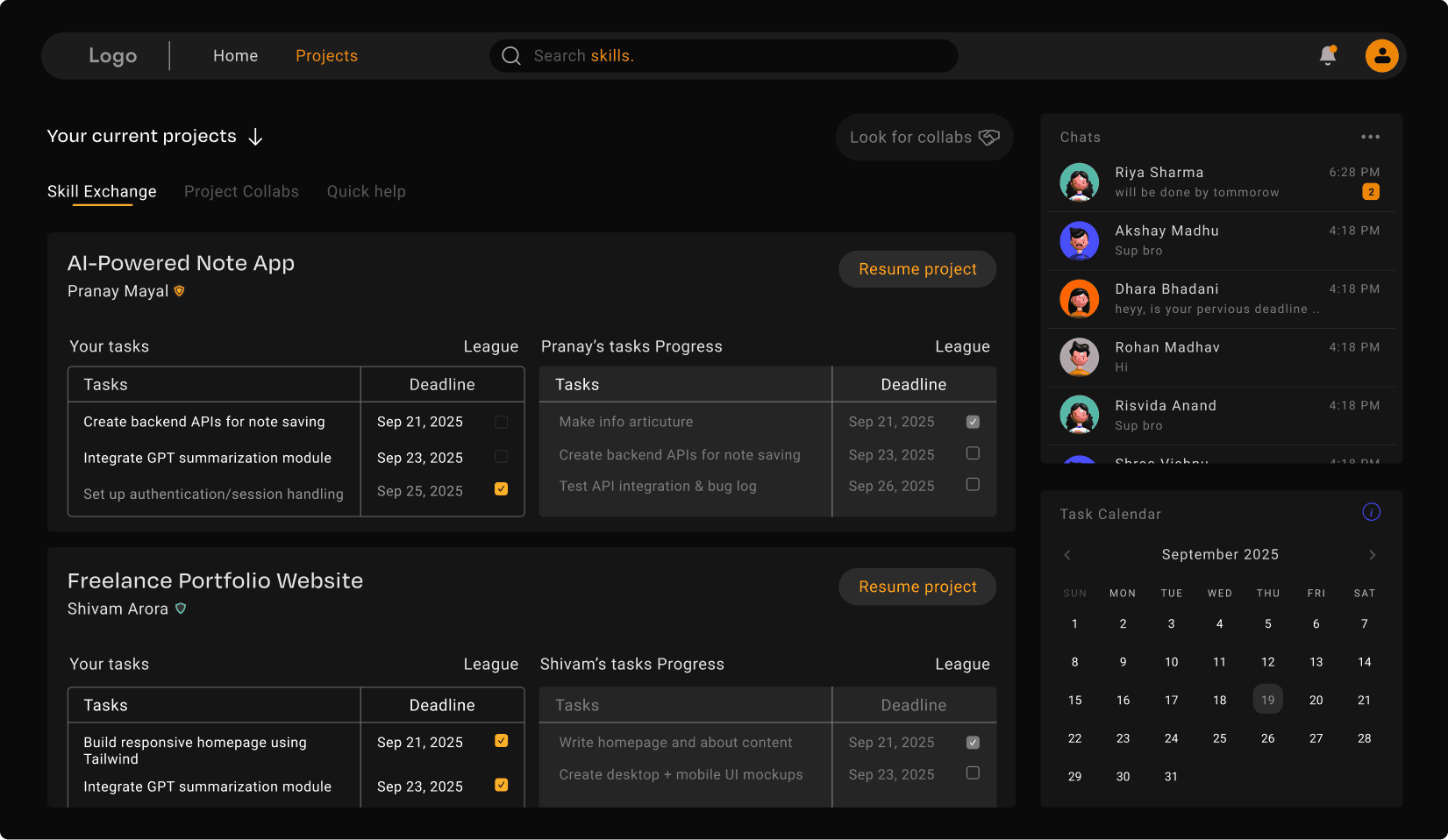
This was a solo project, research, strategy, design, and testing all owned end to end. Conducted across 4 months (January–April 2025), the process included market analysis, competitive benchmarking, 3 user interviews, surveys, information architecture, wireframing, hi-fi design, and usability testing with 11 participants. 10 out of 11 participants rated the process a 8 or above out of 10, and all completed the primary task successfully.
Skillsync
How I Solved It
Research showed people were short on someone reliable to work over having reliable content, especially when they enter a new field, so I built around three ideas.
First, an equal skill swap, because when both people teach and both learn, both have a reason to stay. Second, CredLeague, where trust is earned through real work, so strangers can check a track record instead of taking a risk. Third, three ways to collaborate (exchange, projects, quick help), so people can start with whatever time they have
My Solution
Match people based on what they know and what they want to learn. You know front-end, I know UX, we build something together and both walk away having learned by doing.
Problem
People don’t learn by watching tutorials but by actually working, trying. This seems to be harder than it should be. Small doubts pile up, there’s no one to help, and learning stalls.
The problem it addresses is simple but overlooked. Over 90% of users surveyed had tried to learn a skill outside their expertise, but most hit the same wall. Watching tutorials only gets you so far. Without someone to work alongside, small doubts pile up, feedback never comes, and learning stalls before it sticks. No structured way to find collaborators for real projects. No system for establishing trust.
The platform spans project discovery, collaborator matching, a credibility system called CredLeague, and portfolio building, all built around the principle that the best way to learn is to work.
SkillSync is a peer-to-peer skill-exchange platform for students, professionals and freelancers, collaborating on real projects where both sides teach and both sides learn.
Skill Stack Section UI
SkillSync closes each of those gaps directly. Users post what they're working on and what they need and get matched with someone whose skills complement theirs. User A knows front-end but wants to learn UX, User B knows UX but wants to learn front-end. They collaborate on a real project, and both walk away having learned by doing rather than watching.
To solve the trust problem, I designed
CredLeague:
A credibility system where users earn their way up leagues through skill exchanges, project collaborations, and quick help sessions, so trust is built on a track record. And because every collaboration produces real work, users build a portfolio of actual projects they can show employers or future collaborators.
The visual identity of SkillSync is grounded in contrast #F9BB2F against #1C1C1C, chosen for its 9.88:1 accessibility ratio. Degular leads the typography for its balance between editorial weight and functional clarity, supported by Roboto at body scale.
SkillSync


Connect.
Collab.
Create.
High fidelity UI
This was a solo project, research, strategy, design, and testing all owned end to end. Conducted across 4 months (January–April 2025), the process included market analysis, competitive benchmarking, 3 user interviews, surveys, information architecture, wireframing, hi-fi design, and usability testing with 11 participants. 10 out of 11 participants rated the process a 8 or above out of 10, and all completed the primary task successfully.
Skillsync
Problem
People don’t learn by watching tutorials but by actually working, trying. This seems to be harder than it should be. Small doubts pile up, there’s no one to help, and learning stalls.
My Solution
Match people based on what they know and what they want to learn. You know front-end, I know UX, we build something together and both walk away having learned by doing.
How I Solved It
Research showed people were short on someone reliable to work over having reliable content, especially when they enter a new field, so I built around three ideas.
First, an equal skill swap, because when both people teach and both learn, both have a reason to stay. Second, CredLeague, where trust is earned through real work, so strangers can check a track record instead of taking a risk. Third, three ways to collaborate (exchange, projects, quick help), so people can start with whatever time they have
Video Preview
SkillSync is a peer-to-peer skill-exchange platform for students, professionals and freelancers, collaborating on real projects where both sides teach and both sides learn.
The platform spans project discovery, collaborator matching, a credibility system called CredLeague, and portfolio building, all built around the principle that the best way to learn is to work.
Over 90% of users surveyed had tried to learn a skill outside their expertise, but most hit the same wall. Watching tutorials only gets you so far. Without someone to work alongside, small doubts pile up, feedback never comes, and learning stalls before it sticks. No structured way to find collaborators for real projects. No system for establishing trust.
SkillSync closes each of those gaps directly. Users post what they're working on and what they need and get matched with someone whose skills complement theirs. User A knows front-end but wants to learn UX, User B knows UX but wants to learn front-end. They collaborate on a real project, and both walk away having learned by doing rather than watching.
Skill Stack Section UI
To solve the trust problem, I designed
CredLeague:
A credibility system where users earn their way up leagues through skill exchanges, project collaborations, and quick help sessions, so trust is built on a track record. And because every collaboration produces real work, users build a portfolio of actual projects they can show employers or future collaborators.
The visual identity of SkillSync is grounded in contrast #F9BB2F against #1C1C1C, chosen for its 9.88:1 accessibility ratio. Degular leads the typography for its balance between editorial weight and functional clarity, supported by Roboto at body scale.
#FFFFFF
#1C1C1C
#E7E7E7
#F9BB2F
#F9BB2F : Is Optimism and is Attention-grabbing
Learn by doing,
not watching."
Scale
Degular
Header Size: 36
Sub Header Size: 24
Degular
Roboto
Body text Size: 16
Roboto
Body text 2 Size: 16
SkillSync
Iconography
!
Typography
ABCDEFGHIJKLMNOPQRSTUVWXYZ
abcdefghijklmnopqrstuvwxyz
1234567890
Degular
Connect.
Collab.
Create.
SkillSync
High fidelity UI
This was a solo project, research, strategy, design, and testing all owned end to end. Conducted across 4 months (January–April 2025), the process included market analysis, competitive benchmarking, 3 user interviews, surveys, information architecture, wireframing, hi-fi design, and usability testing with 11 participants. 10 out of 11 participants rated the process a 8 or above out of 10, and all completed the primary task successfully.